Azadirachta indica A. Juss.
| Etymology | Genus | After the Arab common name of the plant |
|---|---|---|
| Species | After India | |
| Family | Meliaceae | |
| Synonyms | Melia azadirachta L. | |
| Common Names | Neem Tree, Chinaberry, Nimtree | |
| Status | Exotic: Casual | |
| Form | Tree | |
| Native Distribution | India, Bangladesh, Indochina | |
Diagnostics
Azadirachta indica, a fairly common cultivated tree, can be easily recognised from its foliage and leaflets. The pinnate leaves spiral around the branches, creating a foxtail-like foliage. Each leaflet is small (about 5cm), sickle-shaped and have serrated margins.
Interesting Facts
In Saudi Arabia, 50,000 Neem Trees are planted on the Plains of Arafat, where the Prophet Mohammad gave his farewell sermon more than 1,000 years ago, to provide shade for Muslim Haj pilgrims (Ahmed et al., 1989). It is regarded as a divine tree by Indians, and is commonly cultivated within temples and homes (Tan & Giam, 2008).
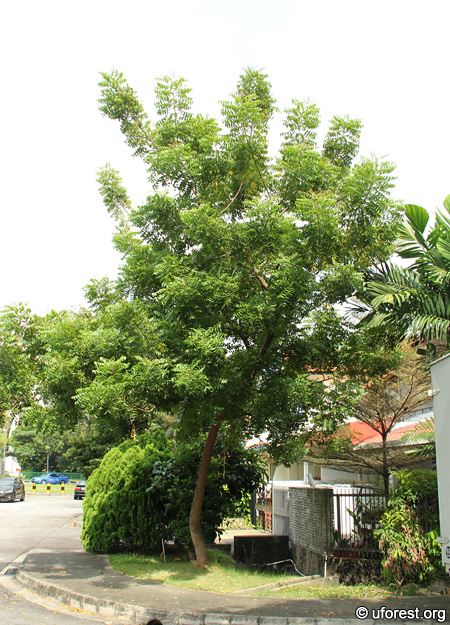
The form of the Neem Tree.
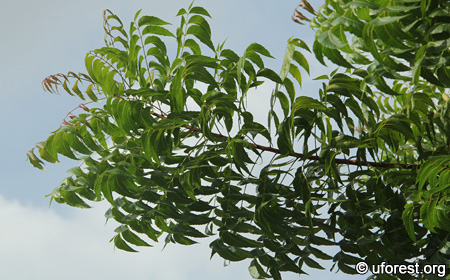
Note the foxtail-like foliage.
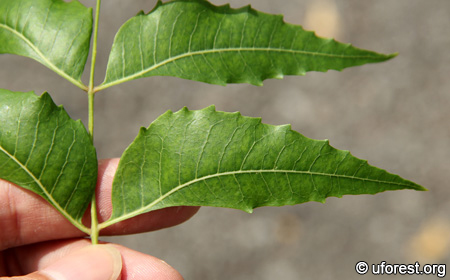
The leaves are sickled-shaped with serrated margins.
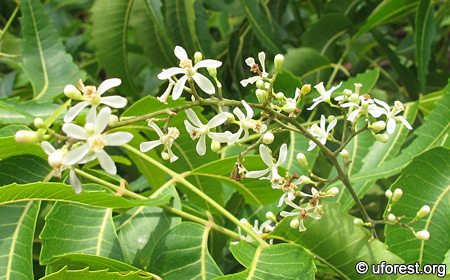
Flowers, taken from a naturalised tree in Lazarus Island.
References
Ahmed S, S Bamofleh & M Munshi. (1989) Cultivation of Neem (Azadirachta indica, Meliaceae) in Saudi Arabia. Economic Botany, 43: 35-38.
Tan HTTW & XL Giam. (2008) Plant Magic: Auspicious and Inauspicious Plants from Around the World. Marshall Cavendish, Singapore. 215 pp.