Borassus flabellifer L.
| Etymology | Genus | Greek word for the fruit of the date palm |
|---|---|---|
| Species | Fan-bearing; referring to the leaf shape | |
| Family | Arecaceae | |
| Synonyms | Borassus sundaicus Becc., Borassus tunicatus Lour. | |
| Common Names | Palmyra Palm, Toddy Palm, Sugar Palm, Cambodian Palm | |
| Status | Exotic: Cultivated Only | |
| Form | Single stem palm | |
| Native Distribution | India, Sri Lanka, Indochina, Peinsular Malaysia, Indonesia, Papua New Guinea | |
Diagnostics
Borassus flabellifer is a common cultivated single stem palm. The leaves are fan-shaped with stiff sharp lobes. The petiole have very fine serrations on the edges. The male and female inflorescences are borne on different trees (Wee, 2003). Fruits are large and rounded, almost 15cm in diameter.
Interesting Facts
The Palmyra Palm is an important economical plant in India (Wee, 2003). The leaves of the Toddy Palm were once used as writing materials; old religious text of Hinduism and Buddhism are written on the them. They are also used in thatching, making fans, mats, baskets, and handbags. Fibers extracted are used for making brushes and brooms. Toddy and palm sugar is made from the the sap of the young inflorescences. Sago is also obtained from the trunk.
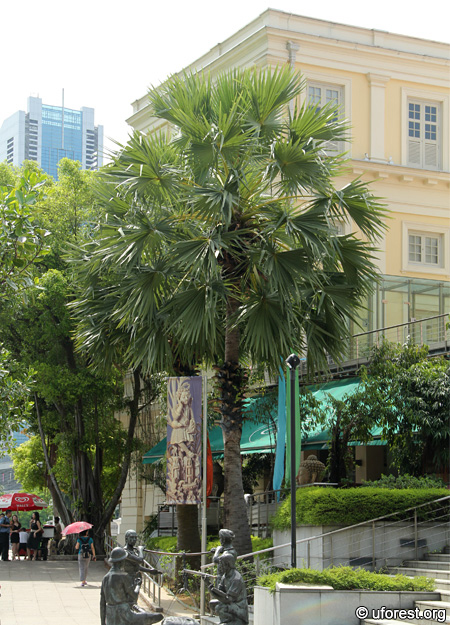
Form of the Toddy Palm outside Asian Civilisation Museum.
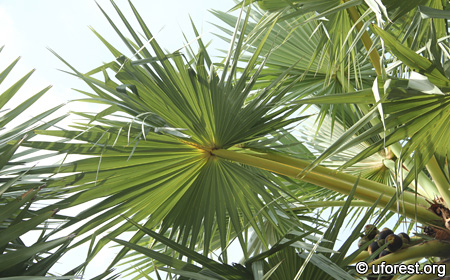
Leaves are palmate.
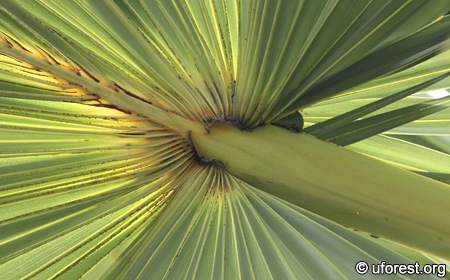
Hastula of the leaf.
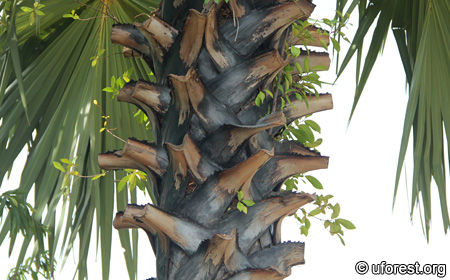
Remains of the leaf stalks after pruning.
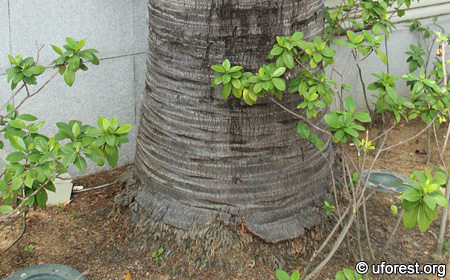
Trunk of the palm.
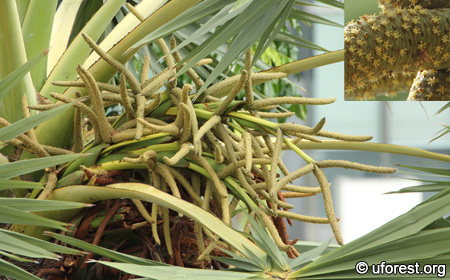
Male inflorescence are branched and tube-like. The flowers are very small.
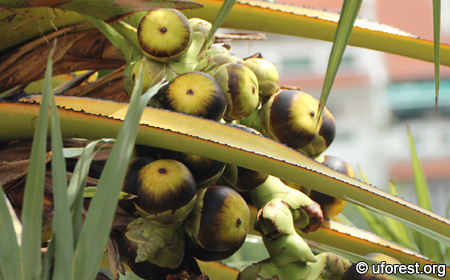
Petiole is finely serrated. The fruits are round and large.