Calotropis gigantea (L.) Dryand.
| Etymology | Genus | Beautiful (kalos) ship's keel (tropis); referring to the ridged floral members |
|---|---|---|
| Species | Gigantic | |
| Family | Apocynaceae | |
| Synonyms | Asclepias gigantea L., Periploca cochinchinensis Lour. | |
| Common Names | Giant Milkweed, Crown Flower | |
| Status | Exotic: Casual | |
| Form | Shrub or small tree | |
| Native Distribution | Indian subcontinent, southern China, Indochina, Malaysia, and Indonesia | |
Diagnostics
This is an ornamental or a butterfly host plant planted in gardens. The opposite leaves have pronounced cordate bases, and the blades are broader towards the tips. A milky exude is produced upon breaking the leaf. It flowers all year round, and the flowers are creamy with purple tips. A variety with completely white flowers is also planted here.
Interesting Facts
The Giant Milkweed contains a number of toxins, with the effects ranging from skin irritation (from the exudes) to cardiac and nervous disorders (when consumed) (Globinmed, 2010). It is one of the host plants for the caterpillar of the Plain Tiger butterfly (Danaus chrysippus chrysippus).
In its native habitat, Calotropis gigantea is found in coastal areas (Malaysia) to semi-desert areas deeper inland (Pakistan) (Ng, 2010).
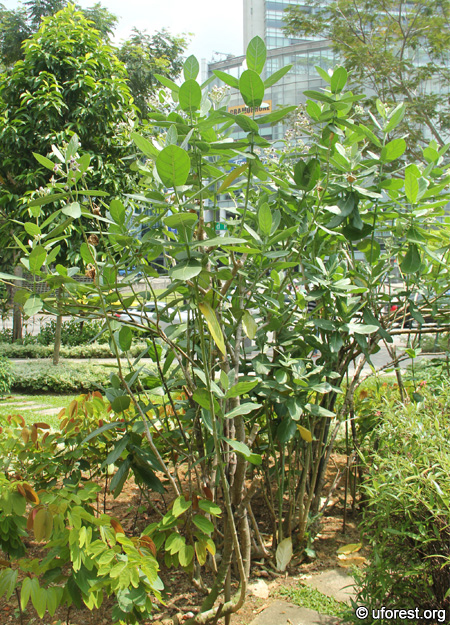
The Giant Milkweed in a butterfly garden.
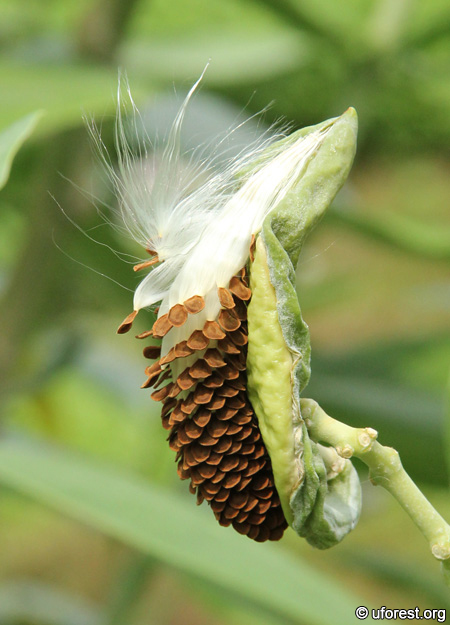
It splits to open numerous brown seeds with white hairs.
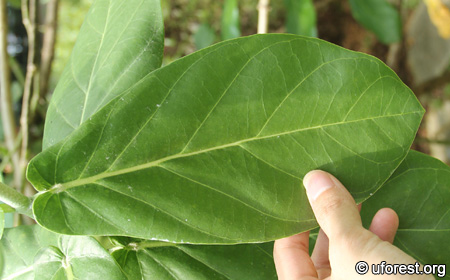
Leaves are large and have a cordate base.
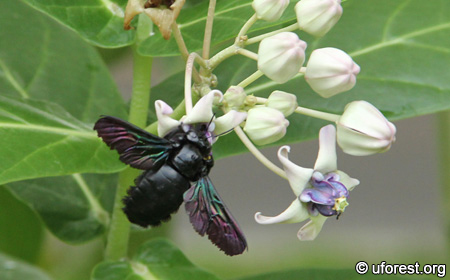
The carpenter bee is a frequent visitor to the flowers.
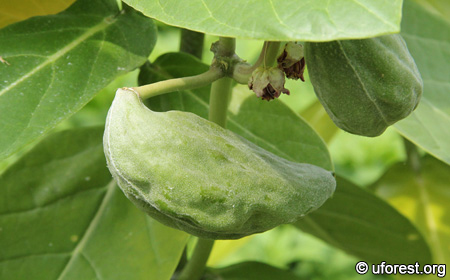
The fruit is a green capsule.
References
Globinmed. (2010) Calotropis gigantea. Global Information Hub on Integrated Science, Institute of Medical Research, Ministry of Health, Malaysia. http://www.globinmed.com. Accessed on 31-Mar-2013.Ng FSP. (2010) Tropical Horticulture & Gardening. MPH Group Publishing, Malaysia. 361 pp.