Cratoxylum cochinchinense (Lour.) Blume
| Etymology | Genus | 'Strong wood' in Greek, referring to the timber |
|---|---|---|
| Species | From Cochinchina, the name used to refer to southern Vietnam during its French colonial period | |
| Family | Hypericaceae | |
| Synonyms | Cratoxylum polyanthum Korth. | |
| Common Names | Red Mempat | |
| Status | Native: Endangered | |
| Form | Tree | |
| Native Distribution | Myanmar, Indo-China, South China, Sumatra, Peninsular Malaysia, Singapore, Borneo, Philippines | |
Diagnostics
Cratoxylum cochinchinense is a tree of up to 30 m tall. Often easily recognisable by its pale brown to reddish-brown bark which is patchy because it peels off in long pieces (Neo et al., 2016).
The lance-shaped or elliptic leaves are quite narrow, thin in texture, and are red when young. The flowers are usually deep red, but they can also be pink or orange.
Interesting Facts
This tree produces a timber which is known by the trade name derum and is moderately hard and moderately heavy to heavy (Wong, 1995). Derum is used for medium to heavy construction, and has been used to make tool handles, wood pallets, and woodcuts. Other parts of the plant are also of value as the young fruit can be used as a spice for cooking, while the twigs, bark, and roots have been used to treat colds and diarrhea (eFloras, 2008).
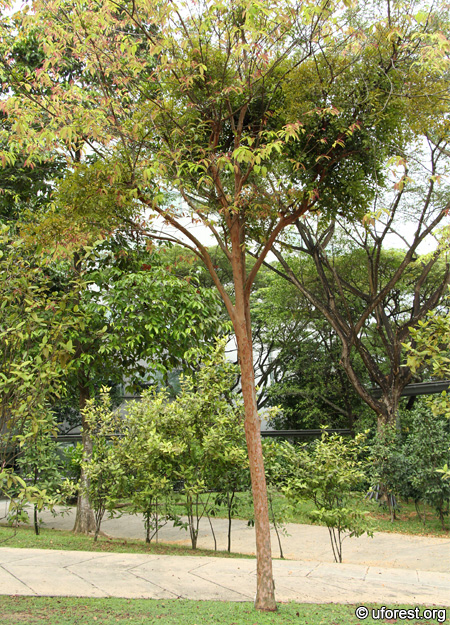
A tree planted on the National University of Singapore campus.
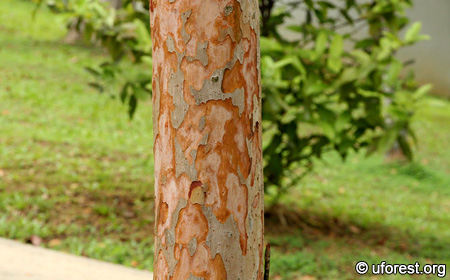
The patch-like pattern of the outer bark after pieces have peeled off.
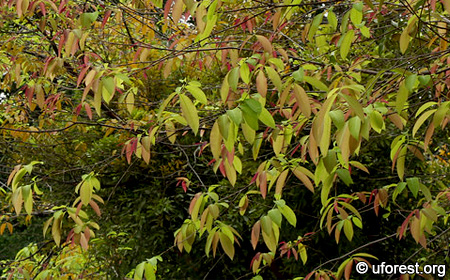
The young leaves are red, making for a distinctive and attractive foliage.
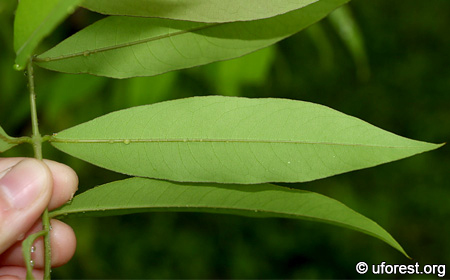
The leaves are narrow with faint but visible veins on the underside.
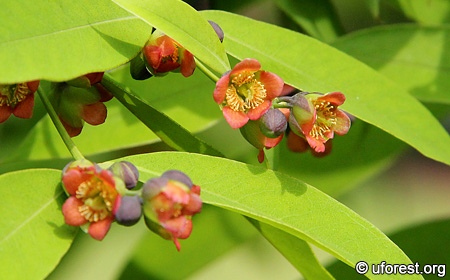
Reddish flowers.
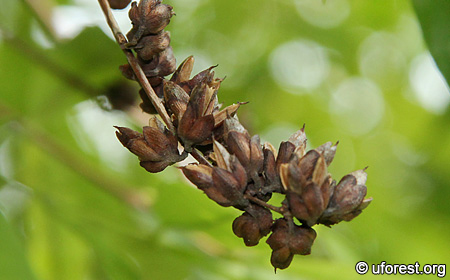
Splitting fruits.
References
Neo L et al. (2016) Towards a field guide to the trees of the Nee Soon Swamp Forest (II): Cratoxylum (Hypericaceae) Nature in Singapore 9: 29-39.Wong KM (1995) Hypericaceae. Tree Flora of Sabah and Sarawak, 1: 219-226.
eFloras (2008) Cratoxylum cochinchinense (Loureiro) Blume. Flora of China. Missouri Botanical Garden, St. Louis, MO & Harvard University Herbaria, Cambridge. http://www.efloras.org/. Accessed on 7-Oct-2017.