Dischidia major (Vahl) Merr.
| Etymology | Genus | Two (Di) and split (schidius); probably referring to the fruit |
|---|---|---|
| Species | Larger; probably referring to the enlarged leaf form | |
| Family | Apocynaceae | |
| Synonyms | Dischidia rafflesiana Wall., Dischidia timorensis Decne. | |
| Common Names | Malayan Urn Vine, Ant Plant, Rattle Sculls | |
| Status | Native: Least Concern | |
| Form | Climber | |
| Native Distribution | Indochina, Malesia, Papua New Guinea, Queensland | |
Diagnostics
A climber that can be found in inland rainforests, coastal regions and mangroves, Dischidia major can be easily identified from its two forms of fleshy leaves. The first the normal one, are circular with a small drip-tip; while the other is a enlarged, elongated and somewhat tongue-like.
Interesting Facts
The modified enlarged leaf form is hollow in the inside, and often used by ants to nest within; serving a mutualistic relationship, the ants protecting the plant from herbivores in return for a home.
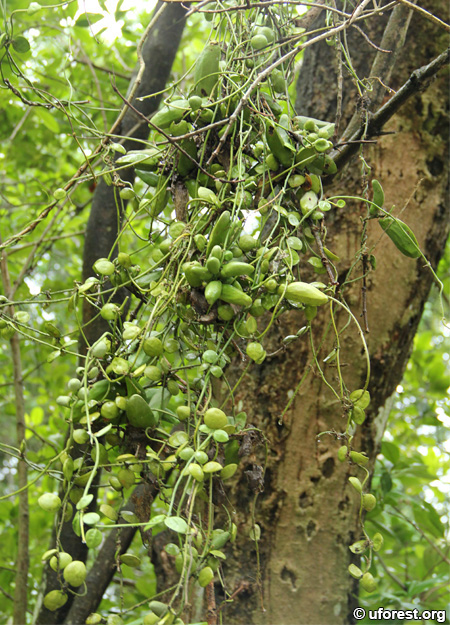
A climber showing the two leaf forms in Mandai Mangroves (2010).
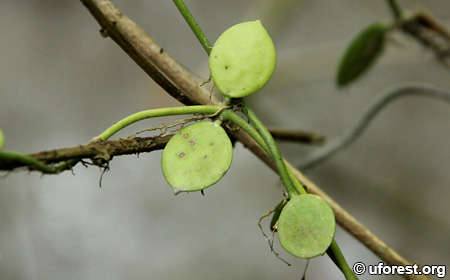
Normal leaves with a small drip tip.
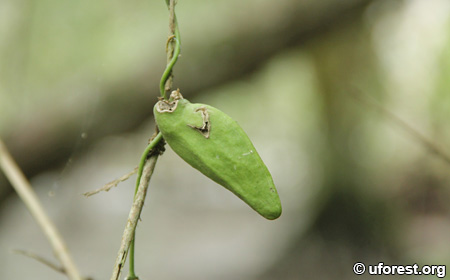
Modified hollow leaf.
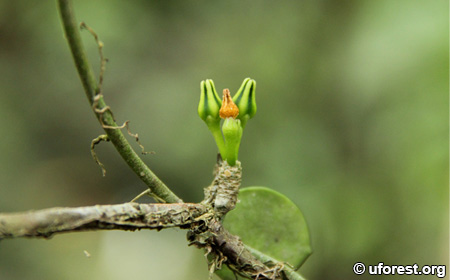
Flowers.
Siyang ·
2019-01-03