Dischidia nummularia R.Br.
| Etymology | Genus | Two (Di) and split (schidius); probably referring to the fruit |
|---|---|---|
| Species | Coin shaped; referring to the leaves | |
| Family | Apocynaceae | |
| Synonyms | - | |
| Common Names | Button Orchid, Pebble Beach | |
| Status | Native: Least Concern | |
| Form | Epiphyte | |
| Native Distribution | Tropical Asia to New Guinea and Australia | |
Diagnostics
From afar, an established Button Orchid will droop down from the branches of its host tree like threads. The leaves are fleshy and the shape ranged from circular to slightly narrow with a pointed tip.
A related species, Dischidia major in my opinion has more circular leaves, but they are larger and frequently have a second type of leaf which is enlarged and hollow for housing ants. D. nummularia also somewhat resembles the common epiphytic fern Pyrrosia piloselloides, but the leaves of this fern has a blunt tip.
Interesting Facts
This is a common epiphyte that can be found occasionally on our urban trees. The flowers are tiny and white. The paired fruits (typical of the family) are elongated and broader near the base, tapering to the tip.
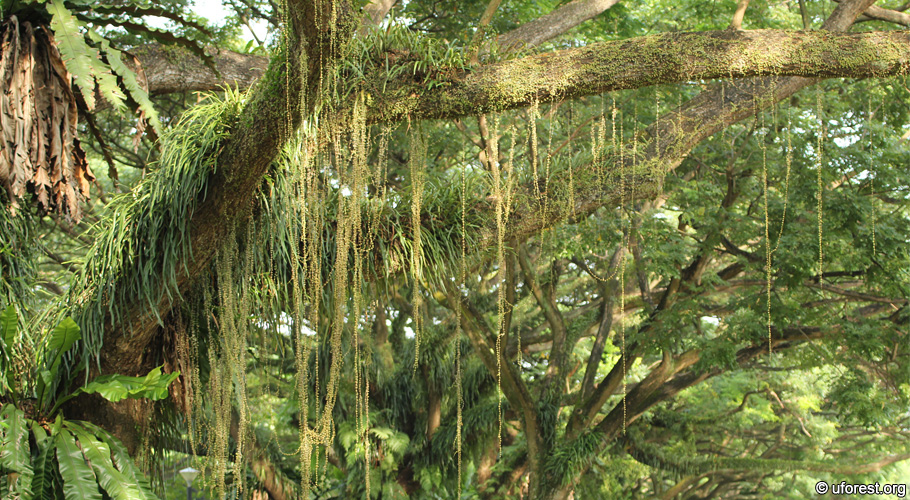
Dischidia nummularia frequently hang down from the tree trunks they grow on.
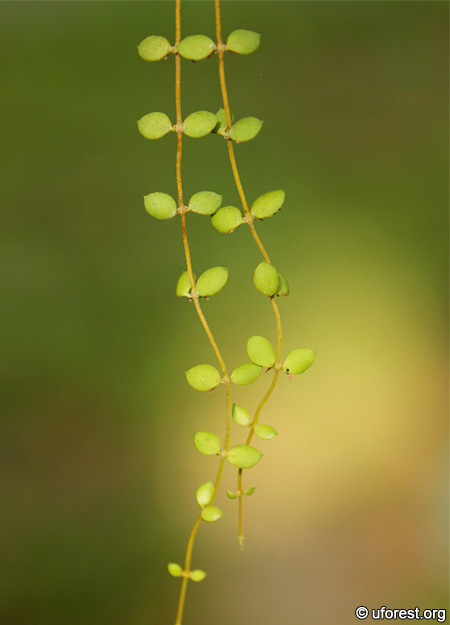
Leaves is coin-shaped with a pointed tip.
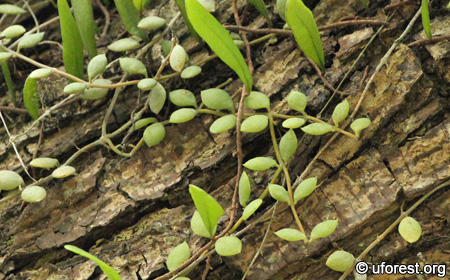
Comparison of Dischidia nummularia and the common Dragon's Scale Fern.
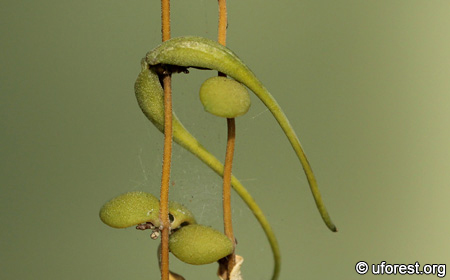
Paired fruits are elongated with a cleft along the centre.
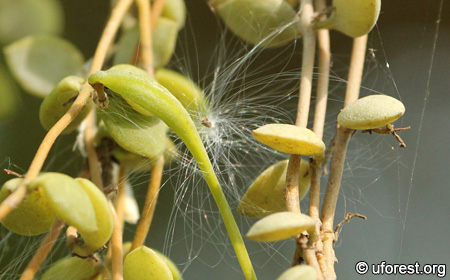
A seed trapped on a web constructed around the plant.