Elaeis guineensis Jacq.
| Etymology | Genus | Olive; referring to the fruit which has huge commercial importance like the olive |
|---|---|---|
| Species | From Guinea, West Africa | |
| Family | Arecaceae | |
| Synonyms | Elaeis dybowskii Hua, Elaeis virescens (A.Chev.) Prain | |
| Common Names | Oil Palm | |
| Status | Exotic: Casual | |
| Form | Single-stem palm | |
| Native Distribution | Africa | |
Diagnostics
Elaeis guineensis is a common palm found in abandoned planatations here. They can either be single-stem or stemless. Cultivated ones have their leaves pruned but their petioles will still persist on the trunk, while old wild ones have a clean stem, somewhat resembling a coconut. However, the leaves have short, sharp spines on the petiole. The leaflets are dark green and rather droopy and messy in appearance.The male and female inflorescences are distinctively different; the former being tubular, and the latter being a nest of tiny flowers.
Interesting Facts
The Oil Palm first came to Southeast Asia with 4 seedlings in 1848 from the island of Mauritius to the Bogor Botanic Garden in Java, of which 2 of them still survive now (Whitemore, 1998). It was first cultivated in Singapore about 1870.
Palm oil, extracted from the fruit of the Oil Palm, is a very commercially important product being used for cooking oil, cosmetics, industrial lubricants, biofuels, and food products (Koh & Wilcove, 2007). Oil Palm plantations are widespread in Indonesia and Malaysia, which are the biggest producers of palm oil in the world (28,500 and 19,000 metric tons respectively in 2013) (USDA, 2013). Clearance of tropical rainforests for planting oil palms is identified as the biggest threat of biodiversity in Southeast Asia (Wilcove & Koh, 2010).
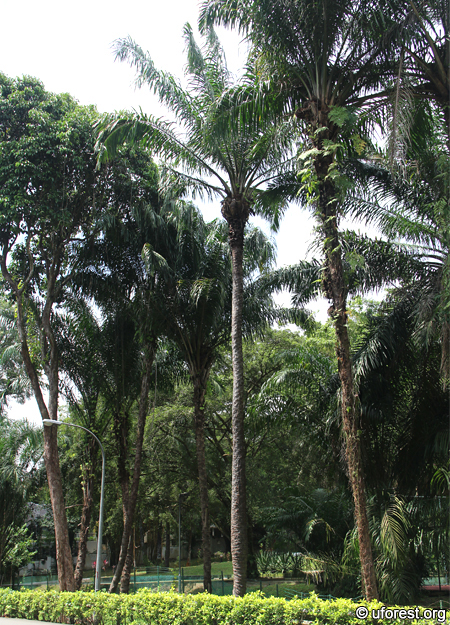
An old Oil Palm without leaf pruning.
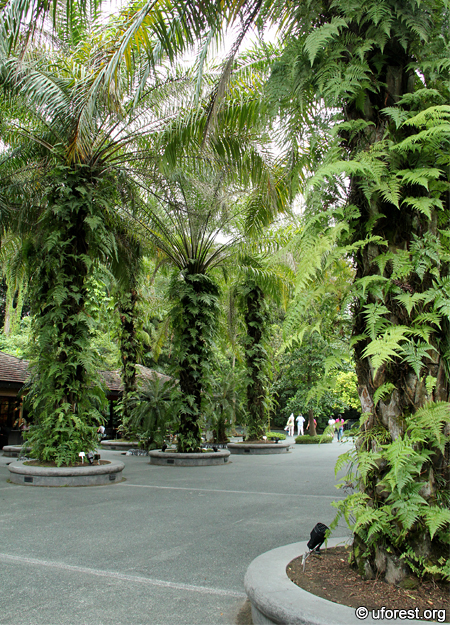
Form with the leaves pruned, leaving the petioles for epiphytes to thrive.
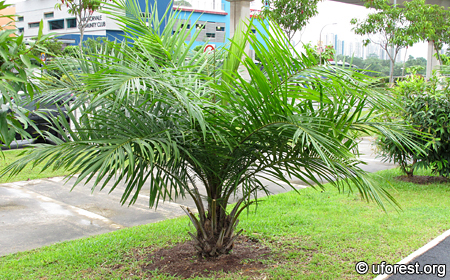
Stemless young Oil Palm.
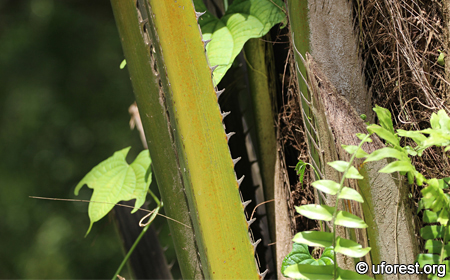
Spines lining the petiole.
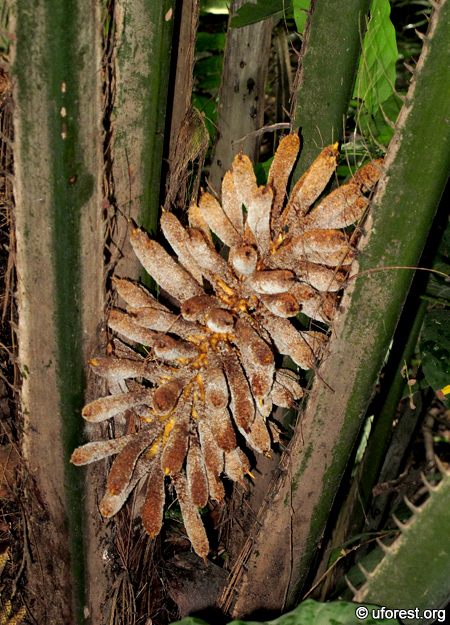
Male inflorescence.
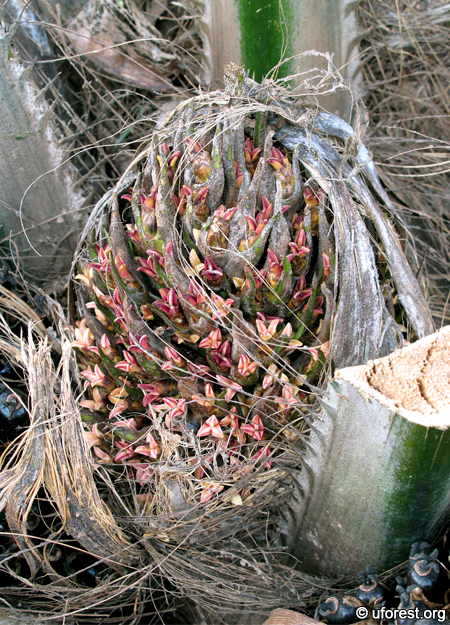
Female inflorescence.
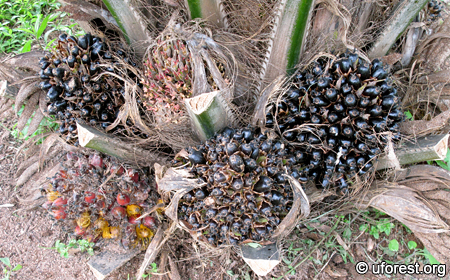
Fruits (ripe ones lower left) and female inflorescence (top centre).
References
Koh LP & DS Wilcove. (2007) Cashing in palm oil for conservation. Nature, 448:993-994.Whitmore TC. (1998) Palms of Malaya. 2nd Edition. White Lotus. 136 pp.
Wilcove DS & LP Koh. (2010) Addressing the threats to biodiversity from oil palm agriculture. Biodiversity Conservation: 19:999-1007.
USDA. (2013) Table 11: Palm Oil: World Supply and Distribution. United States Department of Agriculture. http://www.fas.usda.gov. Accessed on 29-Sep-2013.