Hymenaea courbaril L.
| Etymology | Genus | After Hymen, Greek god of marriage; in reference to the twin leaflets |
|---|---|---|
| Species | After the common name of the timber | |
| Family | Fabaceae | |
| Synonyms | - | |
| Common Names | West Indian Locust Tree | |
| Status | Exotic: Cultivated Only | |
| Form | Tree | |
| Native Distribution | Tropical America | |
Diagnostics
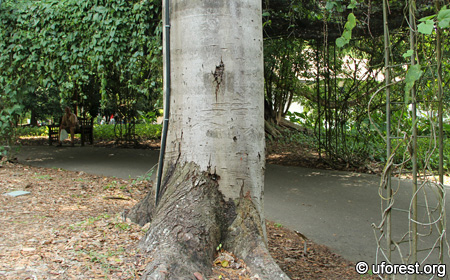
Hymenaea courbaril is a large cultivated tree that is sparingly found in parks. The trunk is smooth and the compound leaves consists of two sickle-shaped leaflets. The bean-shaped pods have a tough covering, which has a foul stench in the interior.
Interesting Facts
The West Indian Locust Tree was introduced to Singapore in 1875 (Corner, 1997). Despite the unpleasant smell of the fruit, Corner recorded the pulp within as being sweet and was sometimes eaten by children.
In its native habitat, the agouti (a rodent) and the peccary a (new world pig) are able to crack open the valves of the legume to feed on the pulp to disperse the seeds in the process (Wee, 2003).
Smooth bark.
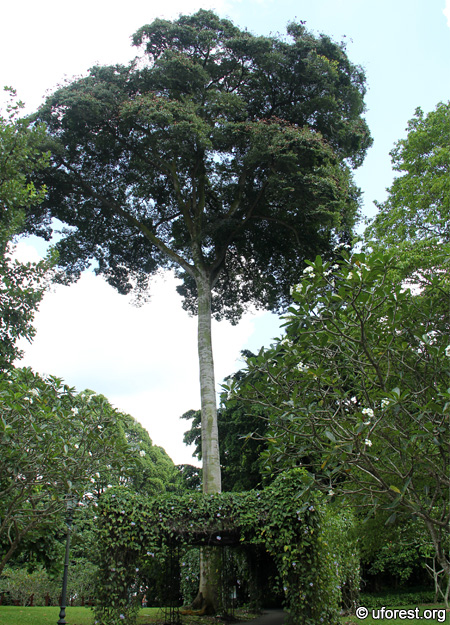
Huge form of the West Indian Locust Tree in the Singapore Botanic Gardens.
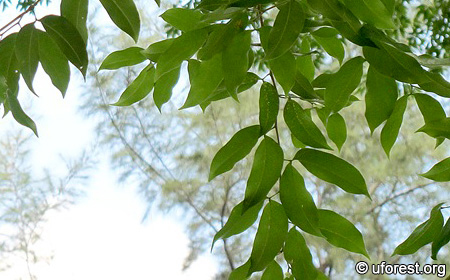
Sickle-shaped bifoliate leaves.
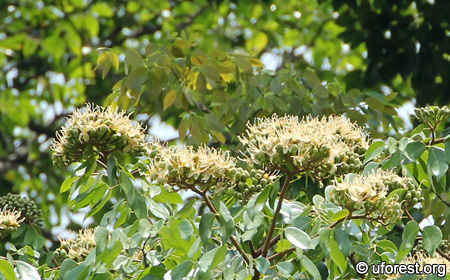
Flowers.
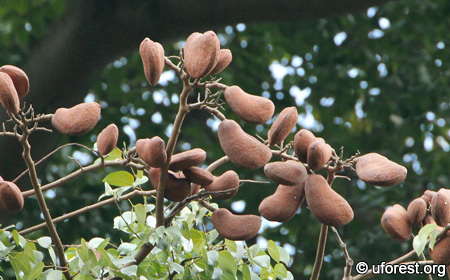
Fruits.
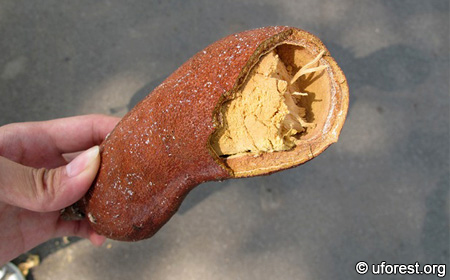
Smashed fruit showing the pulp.
References
Corner EJH. (1997) Wayside Trees of Malaya. Volume 1. 4th edition. The Malaysian Nature Society, Kuala Lumpur. 476 pp.Wee YC. (2003) Tropical Trees and Shrubs: A Selection for Urban Planting. Sun Tree Publishing, USA. 392 pp.