Jasminum elongatum (P.J.Bergius) Willd.
| Etymology | Genus | Latinized from Persian name, yasemin or Arabic, yasamin |
|---|---|---|
| Species | Elongated, referring to the elongated petals. | |
| Family | Oleaceae | |
| Synonyms | Nyctanthes elongata P.J.Bergius, Mogorium elongatum (P.J.Bergius) Lam. | |
| Common Names | Common Malayan Jasmine | |
| Status | Native: Endangered | |
| Form | Climber | |
| Native Distribution | China, India, Indonesia, Malaysia, Mynamar, Vietnam, North Australia. | |
Diagnostics
A scrambling climber to 7m in sunny areas. Leaves are oppositely arranged, glabrous with no obvious tertiary veins. It is most obviously distinct from the pretty flower clusters, with white petals arranged in a star-shaped.
Interesting Facts
The Common Malayan Jasmine is used in traditional Chinese medicine for analgesic and antidiarrheal, as well as its anti-inflammatory effects in gastrointestinal diseases (Qiu et al., 2023).
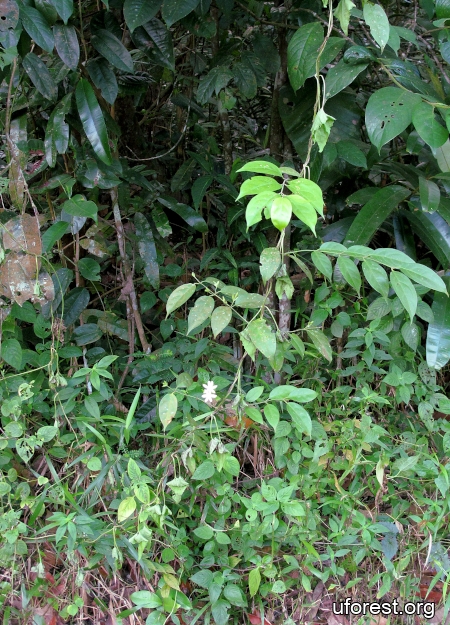
Along a trail in Central Catchment (2011).
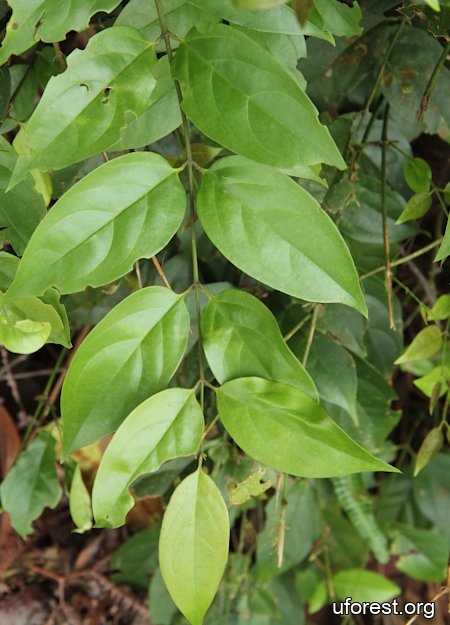
Leafy branch.
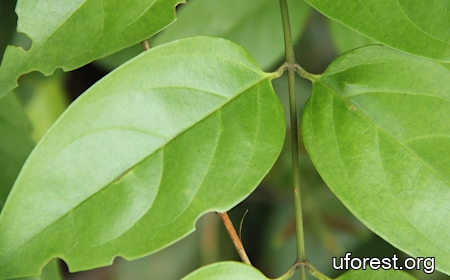
Leaf upper surface.
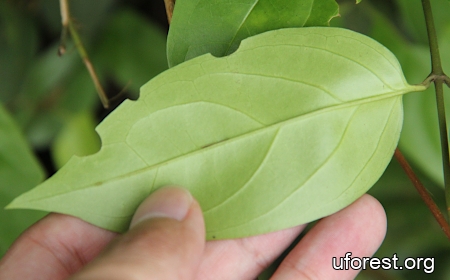
Leaf lower surface.
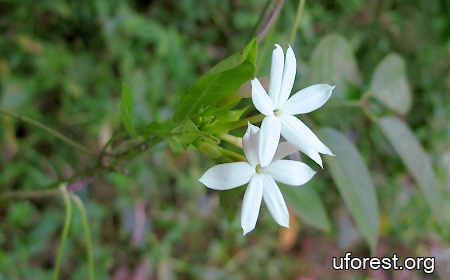
Flowers side view.
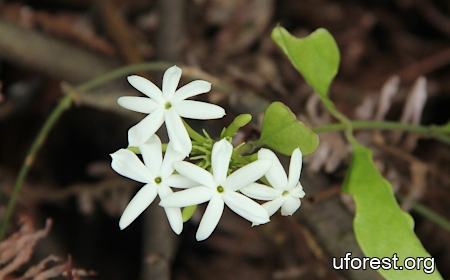
Flowers.
References
Qiu, J., Xiao, G., Yang, M., Huang, X., Cai, D., Xie, C., Chen, Z., Bi, X., & Xu, A. (2023). Integrated network pharmacology and metabolomics reveal the mechanisms of Jasminum elongatum in anti-ulcerative colitis. Scientific Reports, 13, 22449.