Mangifera caesia Jack
| Etymology | Genus | Mango-bearing |
|---|---|---|
| Species | Lavender coloured | |
| Family | Anacardiaceae | |
| Synonyms | - | |
| Common Names | Binjai | |
| Status | Exotic: Casual | |
| Form | Tree | |
| Native Distribution | Malesia, Sumatra | |
Diagnostics
Mangifera caesia is a large tree up to 35m (Ding Hou, 1978), with near obovate leaves and a thick, raised mid vein. Not sure if this is a characteristic trait, but pine nuts-like structures are present at the terminal of the branches . Only this mango species in Malaya (which includes Singapore) have lavender coloured flowers (Corner, 1997).
Interesting Facts
Binjai used to be planted in the past by kampongs for their sour tasting fruits (NParks, 2009). A number of large mature Binjai still exist and are designated as heritage trees. Corner (1997) warned that of the irritable sap of mangoes, and citied Binjai as one of the most poisonous.
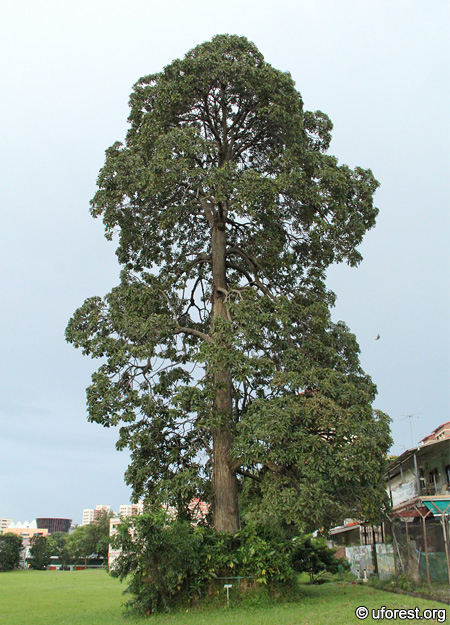
A heritage tree located next to Hougang MRT.
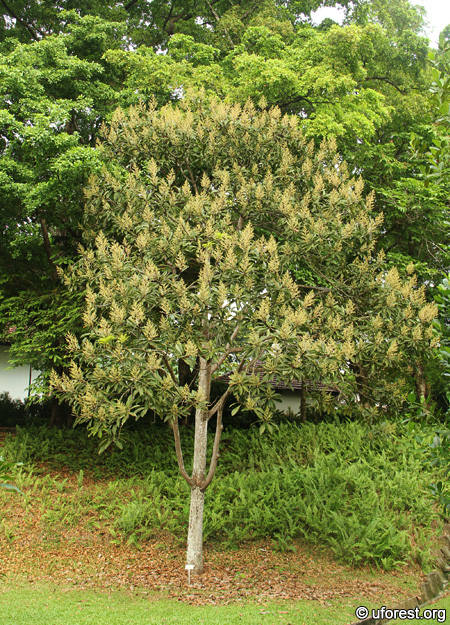
A flowering Binjai in Singapore Botanic Gardens.
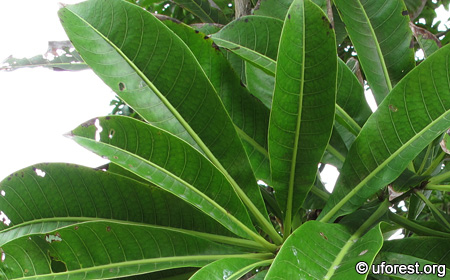
Leaves. Note the thick and raised mid vein.
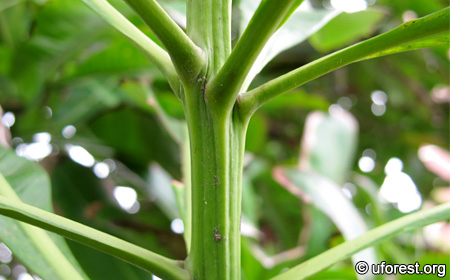
Branch.
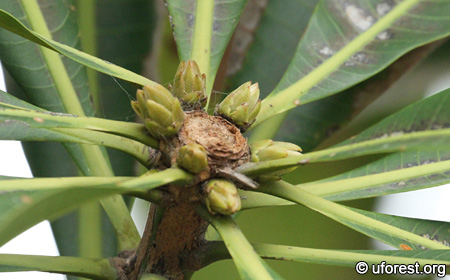
What look like a cluster of developing buds.
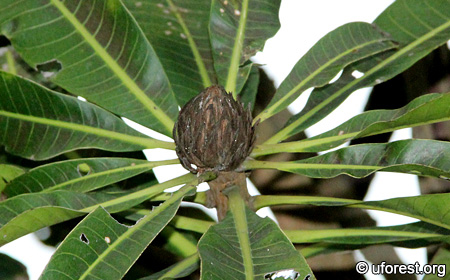
One that has grown large and dried.
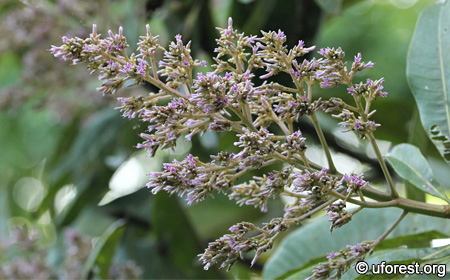
Flowers are lavender-coloured
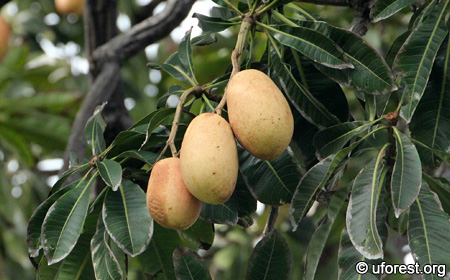
Potato-like fruits.
References
Corner EJH. (1997) Wayside Trees of Malaya. Volume 1. 4th edition. The Malaysian Nature Society, Kuala Lumpur. 297 pp.Ding Hou. (1978) Anacardiaceae. Flora Malesiana, 8: 395-548.
NParks. (2009) Heritage Tree Register. Last updated 19-May-2013. https://www.nparks.gov.sg. Accessed on 5-Jul-2014.