Muntingia calabura L.
| Etymology | Genus | After the Dutch botanist, Abraham Munting |
|---|---|---|
| Species | Unknown | |
| Family | Malvaceae | |
| Synonyms | Muntingia rosea H. Karst. | |
| Common Names | Jamaican Cherry, Cherry Tree, Buah Cheri, Malayan Cherry | |
| Status | Exotic: Naturalised | |
| Form | Tree | |
| Native Distribution | Tropical America | |
Diagnostics
Muntingia calabura is a short tree with a wide spreading crown. The alternate leaves are droopy and edges are serrated (more pronounced near the tips). The branching is very distinctive, separating at a 45 degree angle.
Interesting Facts
The Jamacian Cherry was brought from Mexico to Philippines and then to Thailand, before coming to Peninsular Malaysia and subsequently Singapore (Rao & Wee, 1989). However, it has lost its popularity now because of the droppings passed out by birds and bats which eat the edible fruits and dirty the surroundings (Rao & Wee, 1989). It is now planted sparingly in some parks and the streetscape, and well as growing wild in young secondary forests.
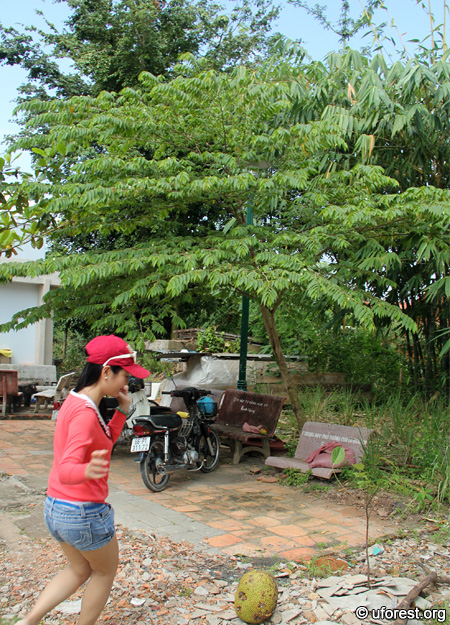
Form of the Jamacian Cherry.
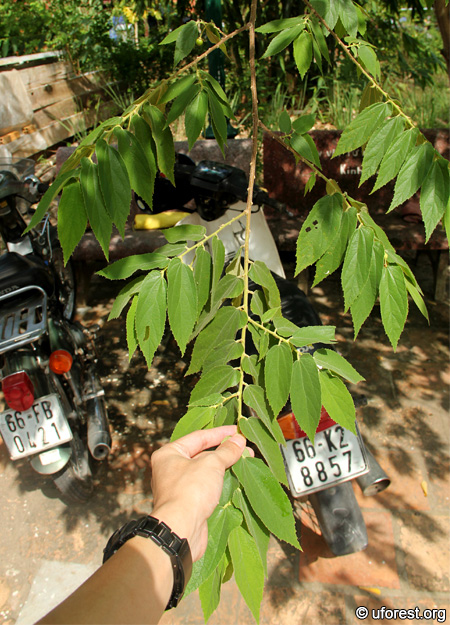
Note the 45 degree branching.
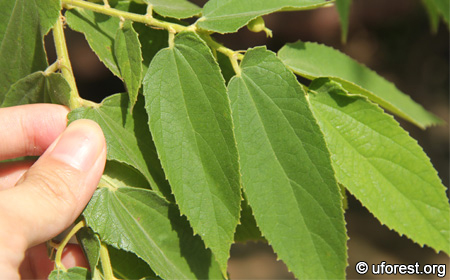
Leaves are serrated, especially near the tips.
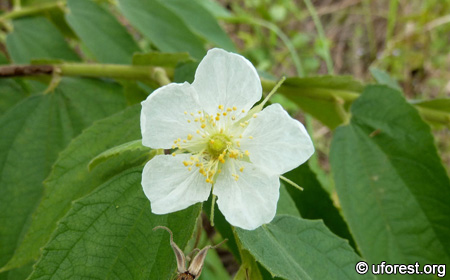
White flowers are bisexual.
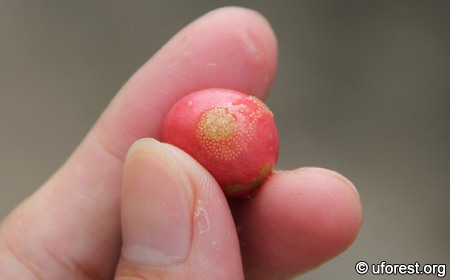
Many tiny seeds exude out when pressed.