Neptunia plena (L.) Benth.
| Etymology | Genus | After Neptune, a god in Greek mythology |
|---|---|---|
| Species | Plenty, full, or double. The reference to the plant is unknown. | |
| Family | Fabaceae | |
| Synonyms | Mimosa plena L. | |
| Common Names | Dead and Awake, Aquatic Sensitive Plant | |
| Status | Exotic: Naturalised | |
| Form | Shrub | |
| Native Distribution | Tropical America | |
Diagnostics
A woody shrub very common in terrestrial and aquatic scrublands. It flowers very often and the yellow flower clusters are distinctive. Another congenor, Neptunia oleracea, has similar flowers but lesser pairs of leaflets (less than 20 while N. plena has more than 20; Windler [1966]).
Interesting Facts
The Dead and Awake plant has naturalised in every continent except the Antartica (for details, refer to Hannan-Jones & Csurhes [2008]). Their common name is likely to be from the sensitive leaves which will close upon touch, just like the Mimosa (Mimosa pudica). However, their response time seems more lethargic than the Mimosa.
When it grows over water, the stems will develop spongy, fibrous tissues which help in buoyancy.
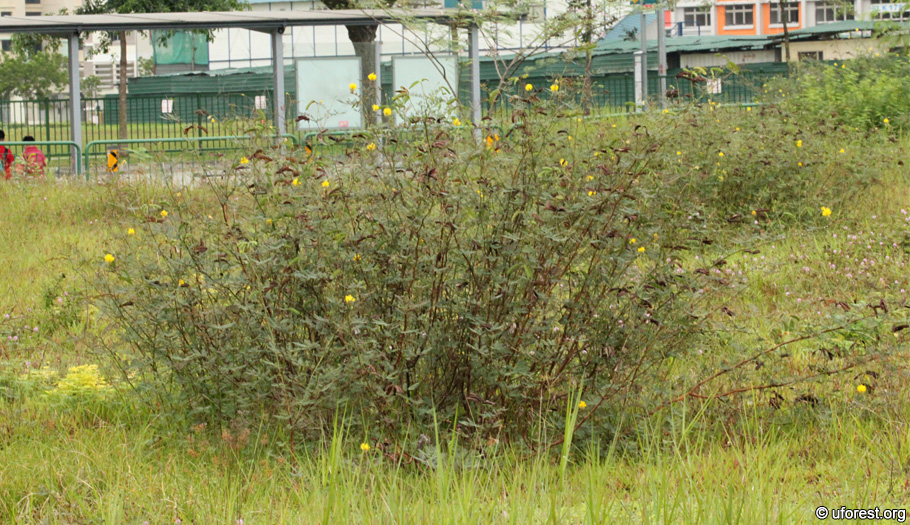
A thicket of Neptunia plena in a scrubland.
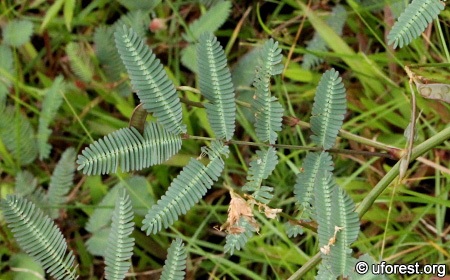
Bipinnate leaves with leaflets of more than 20 pairs.
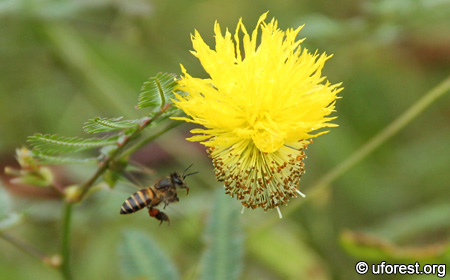
A honey bee approaching the flower cluster.
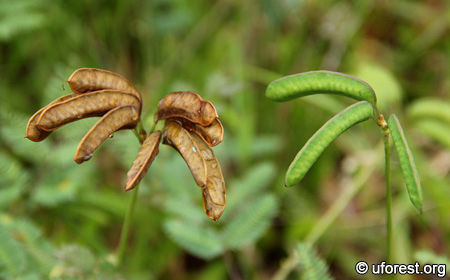
Fruit pods ripe (left) and unripe (right).
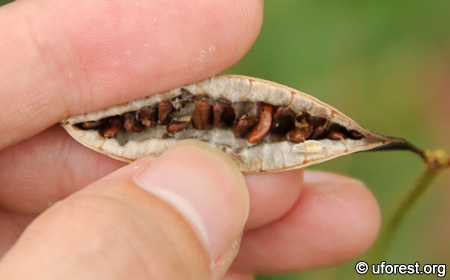
The legume split at the top and reveal numerous brown seeds.
References
Hannan-Jones M. & S. Csurhes. (2008) Pest Plants Risk Assessment: Water Mimosa, Neptunia oleracea; Dead and Awake, Neptunia plena. Department of Primary Industries and Fisheries, Queensland. 14 pp.Windler DR. (1966) A revision of the Genus Neptunia (Leguminosae). Australian Journal of Botany, 14: 379-420.