Punica granatum L.
| Etymology | Genus | After the Roman common name of the plant, punicum malum |
|---|---|---|
| Species | Many seeds | |
| Family | Lythraceae | |
| Synonyms | - | |
| Common Names | Pomegranate | |
| Status | Exotic: Cultivated Only | |
| Form | Shrub | |
| Native Distribution | India, Western Asia | |
Diagnostics
Punica granatum is a very common shrub cultivated at private gardens for its edible fruits. It has a shrubby form with sparse foliage due to its thin leaves. The leaves are oppositely arrange, elongated and with reddish petioles. The fruits are impossible to not to recognise.
Interesting Facts
The Pomegranate was mentioned in the Old Testament on several occasions. The fruit was used as decorations on Hebrew priests' robes (Exodus 28: 33-34) and temples (1 Kings 7: 18, 20, 42; Jeremiah 52: 22-23), and was named as one of the seven food of the land God promised to the Israelis (Deuteronomy 8: 8).
In Buddhism, the Pomegranate is one of the three scared fruits together with the Citrus and Peach.

Form of the Pomegrande; shrubby and sparse thin foliage.
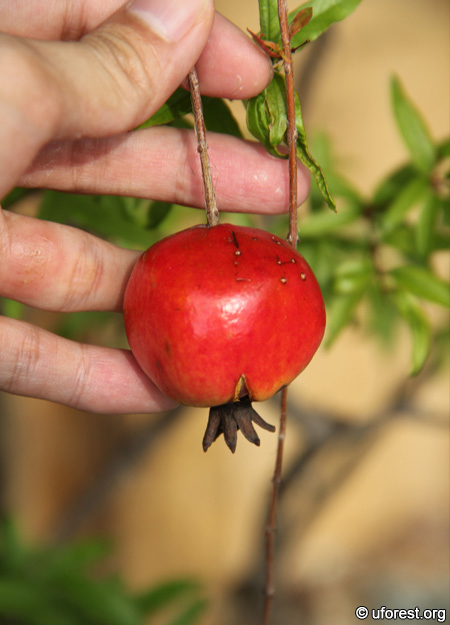
Bright red fruit with the persistant calyx at the tip.
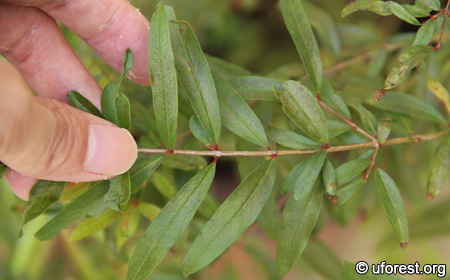
Leaves are opposite, elongated, and have red petioles.
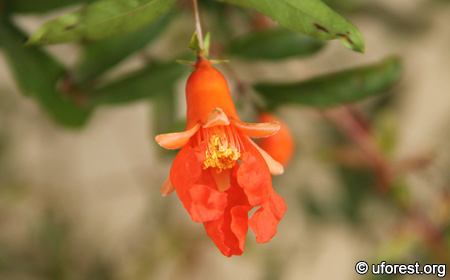
Flower. Note the bell-shaped calyx that form the tip of the fruit.
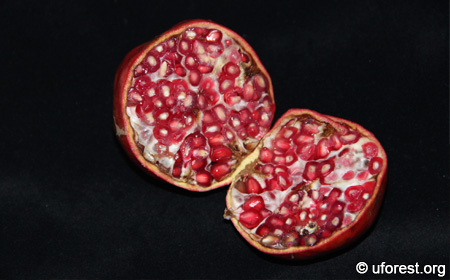
Sliced fruit showing the seeds and flesh around them.