Ruellia simplex C. Wright
| Etymology | Genus | After Jean Ruel, 16th century French botanist |
|---|---|---|
| Species | Simple, unbranched | |
| Family | Acanthaceae | |
| Synonyms | Ruellia brittoniana Leonard, Ruellia microphylla Cav., Ruellia spectabilis (Hook.) G. Nicholson | |
| Common Names | Mexican Blue Bells, Mexican Petunia, Spanish Ladies | |
| Status | Exotic: Naturalised | |
| Form | Herb | |
| Native Distribution | America (Mexico to Uruguay) | |
Diagnostics
Ruellia simplex is a erect herb up to 1m tall, and prefers moist wet habitats. It has very distinct linear leaves, squarish stems, and pink to purple flowers, depending on the cultivar.
Interesting Facts
The Mexican Blue Bells is commonly cultivated as an ornamental plant, but has escaped from cultivation here. I have seen many reproductive individuals especially in canals; therefore its current status should be at the very least, casual. It is able to tolerate a wide range of environmental conditions, and is considered invasive a number of countries, including Australia (Weeds of Australia, 2012), where it can form dense thickets and out-compete native species.
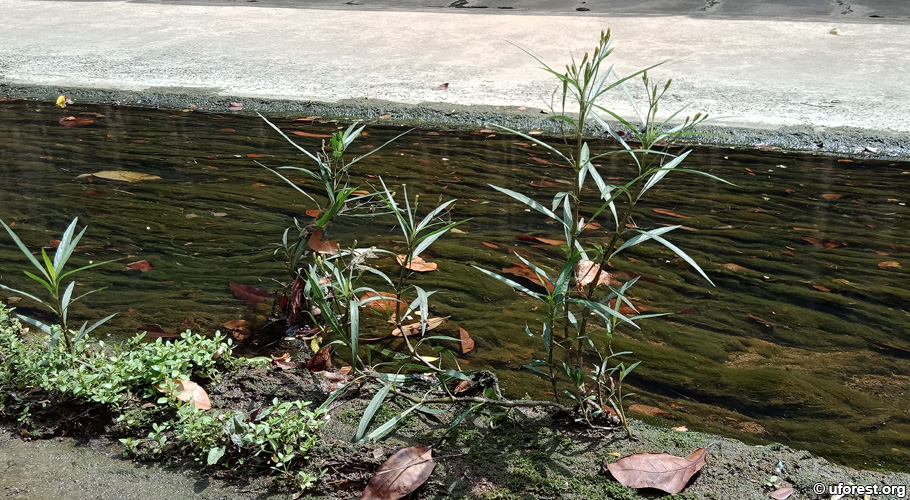
A cluster growing along a canal.
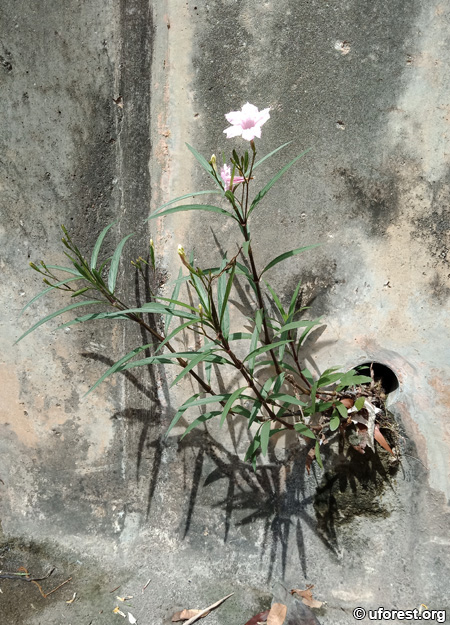
Another flowering stalk from an opening of the canal.
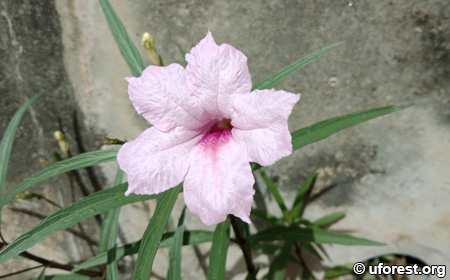
Flowers can come in different colours.
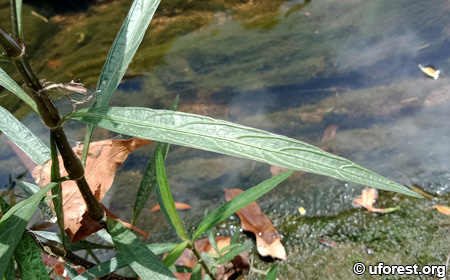
Narrow leaves.
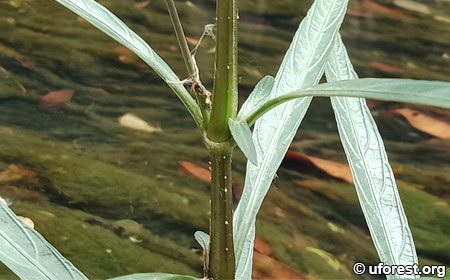
Squarish stem.
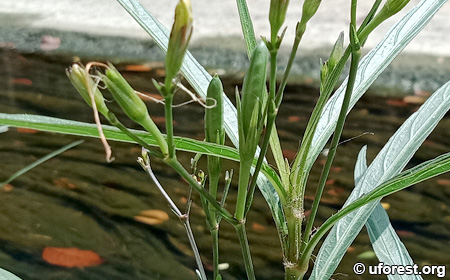
Unripe fruits.
References
CABI (n.d.). Ruellia simplex (Mexican petunia). Invasive Species Compendium, Centre for Agriculture and Bioscience International. https://www.cabi.org/ISC. Accessed on 20-Jan-2019.
Weeds of Australia (2012) Weeds of Australia, Biosecurity Queensland Edition. http://keyserver.lucidcentral.org. Accessed on 20-Jan-2019.