Scoparia dulcis L.
| Etymology | Genus | Broom-like; likely referring to the flowers |
|---|---|---|
| Species | Sweet or tender; reference to plant unknown | |
| Family | Plantaginaceae | |
| Synonyms | Capraria dulcis (L.) Kuntze | |
| Common Names | Sweet Broom Weed | |
| Status | Exotic: Naturalised | |
| Form | Herb | |
| Native Distribution | Tropical America | |
Diagnostics
Scoparia dulcis is a herb of about 30cm high, found in lawns, scrublands, or concretised areas. The leaves have serrated margins halfway towards the tip. The plant flowers and fruits perpetually, so it is not difficult identify using the floral characteristics.
Interesting Facts
The Sweet Broom Weed is known to have hypoglycaemic, anti-tumour, anti-microbial, as well as anti-fungal properties (Mishra et al., 2011). The entire part of the plant, including the roots, has been used traditionally for many ailments; including for coughs, diabetes, burns, fever, diarrhoea, and snake bites (Mishra et al., 2011).
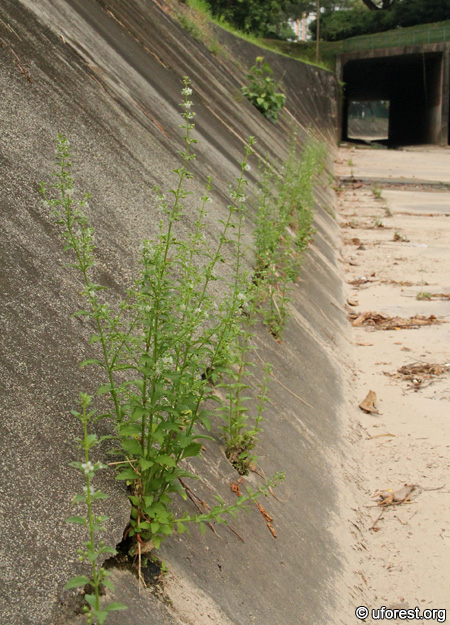
Lush growth of the Sweet Broom Weed in a concretised canal.
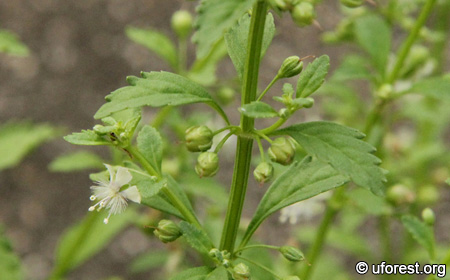
The leaves, flower, and globose fruits.
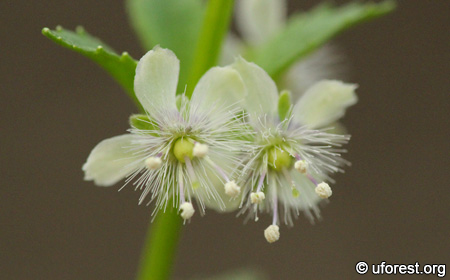
White flower with numerous hairs.
References
MR Mishra, RK Behera, S Jha, AK Panda, A Mishra & DK Pradhan (2011) A brief review on phytoconstituents and ethnopharmacology of Scoparia dulcis linn. (Scrophulariaceae). International Journal of Phytomedicine, 3: 422-438.
Siyang ·
2014-10-19 / Modified: 2018-11-25