Syzygium myrtifolium Walp.
| Etymology | Genus | Jointed (Syzygos), referring to its paired leaves |
|---|---|---|
| Species | Having leaves (folium) like those in the Myrtus (Myrti) genus | |
| Family | Myrtaceae | |
| Synonyms | Syzygium campanulatum Korth., Eugenia oleina Wight | |
| Common Names | Red Lip, Kelat Oil | |
| Status | Native: Critically Endangered | |
| Form | Tree, very commonly pruned to a shrub | |
| Native Distribution | Indochina (Myanmar, Thailand) and Malesia (Malaysia, Singapore, Indonesia, Philippines) | |
Diagnostics
The young leaves of Syzygium myrtifolium are often either yellow or orange. The leaves are elliptic and the intermarginal veins runs very closely to the leaf margins. Because of its dense foliage from the bottom to the top, they are very commonly planted very closely to form hedges for visual or sound blockage. It is also frequently pruned as a low shrub.
Interesting Facts
The Red Lip is naturally found near coastal areas (Kochummen, 1978). However, while native, it is presumed to be nationally extinct in Singapore. Small saplings of this species can sometimes be found wild but these are likely to originate from the massive cultivated stocks planted all over the island.
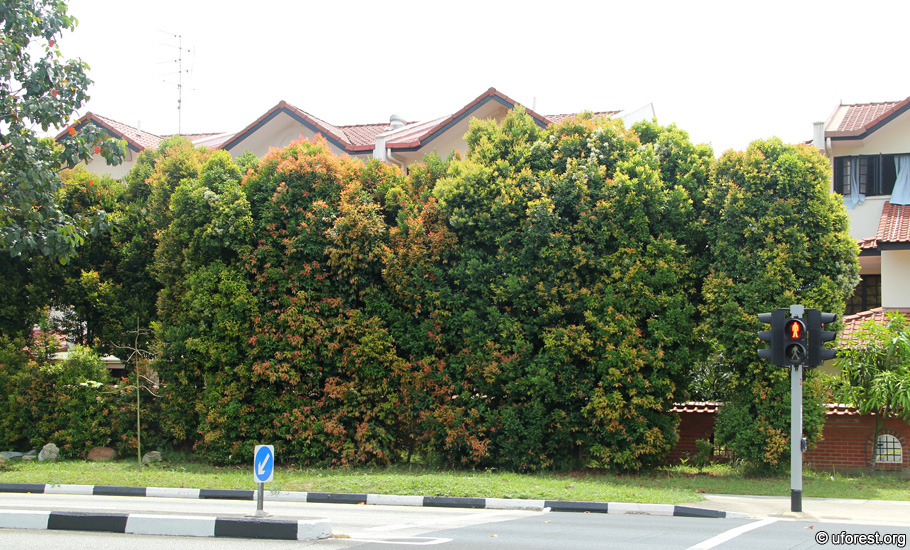
Syzygium myrtifolium is frequently planted close together so that it form a thick hedge.
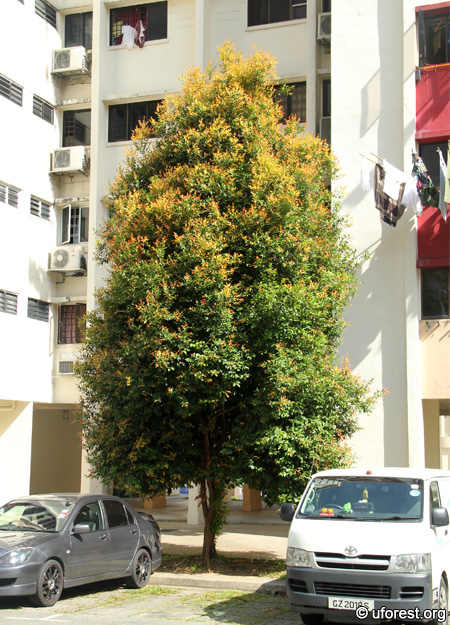
An individual tree about 7 meters tall.
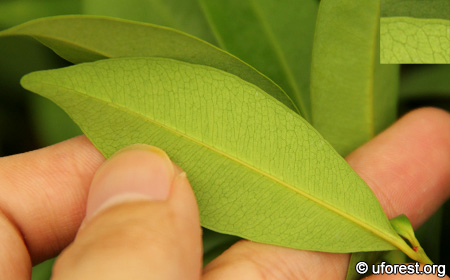
Leaf underside; zooming in on the intermarginal veins.
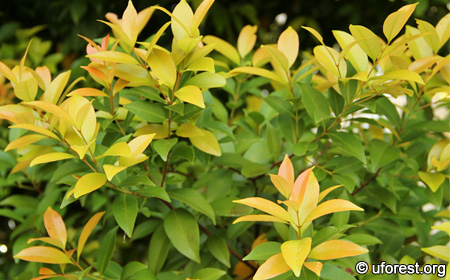
The young leaves are often orange-yellow.
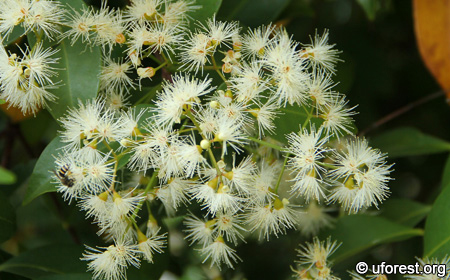
Flowers are small (1.5 cm) and fluffy.
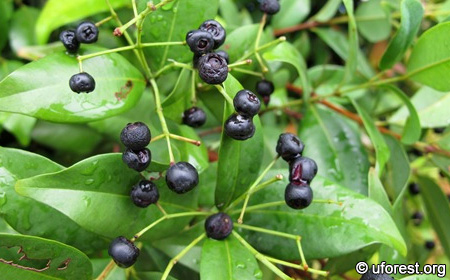
The fruits are black berries.
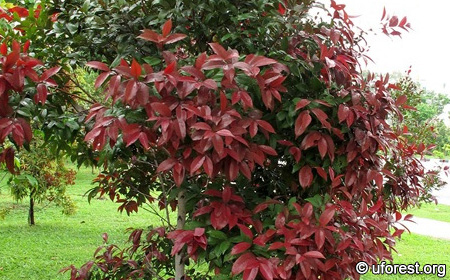
A cultivar showing dark red young leaves.