Wrightia religiosa (Teijsm. & Binn.) Kurz
| Etymology | Genus | After William Wright, a 19th century Scottish physician and botanist |
|---|---|---|
| Species | Of religious significance: Thai Buddhists cultivated it at their temples | |
| Family | Apocynaceae | |
| Synonyms | Echites religiosus Teijsm. & Binn. | |
| Common Names | Water Jasmine, Wild Water Plum, Common Wrightia, Scared Buddha | |
| Status | Exotic: Casual | |
| Form | Shrub or small tree | |
| Native Distribution | Thailand, Cambodia, and Peninsular Malaysia | |
Diagnostics
This plant is very recognisable by its numerous white flowers which bloom frequently. The flowers are five-petalled and have a "beak" at the centre. The leaves are thin, elliptic, oppositely arranged, and gives off white sap when broken.
Interesting Facts
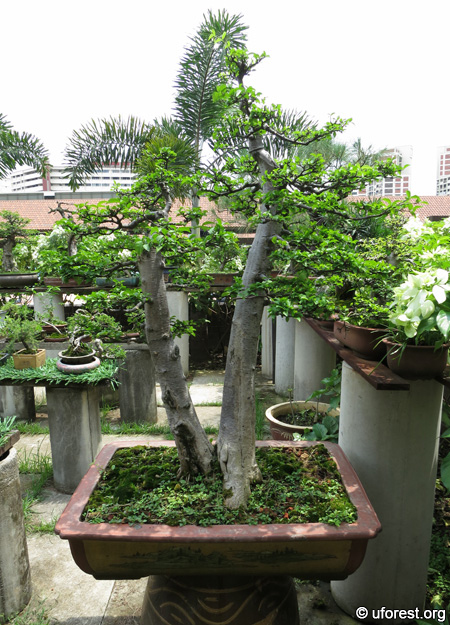
The Water Jasmine can grow up to 5m naturally (Middleton, 2007). However, its dwarfed appearance is more well-known in tropical bonsai, where it is probably one of the most popular species being used. The fruits are paired and elongated, which splits to reveal a row of seeds with fluffy white hairs.
Middleton (2007) indicated that the native distribution of Wrightia religiosa (indicated above) is obscured because of its wide-spread cultivation around the region.
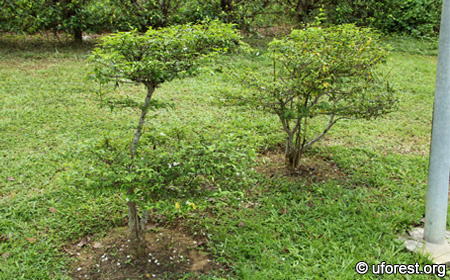
A normal shrubby form.
A Water Jasmine bonsai.
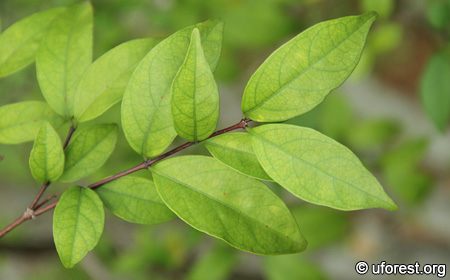
Oppositely arranged elliptic leaves
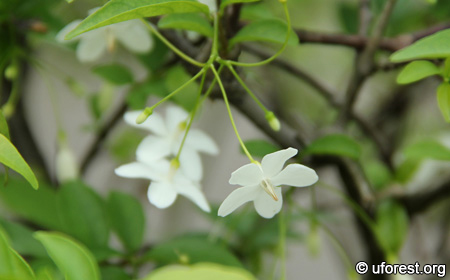
The pendulous flowers.
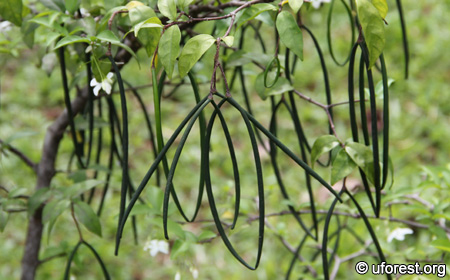
Unripe paired fruits.
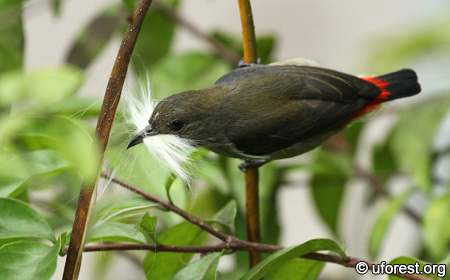
A Scarlet-backed Flowerpecker collecting the fluffy seeds in its mouth.